

How to Start Networking in Film and TV When You Know Nobody
I started trying to build a career in film and TV from Denmark without knowing a single person in the industry. No producers. No executives. No...
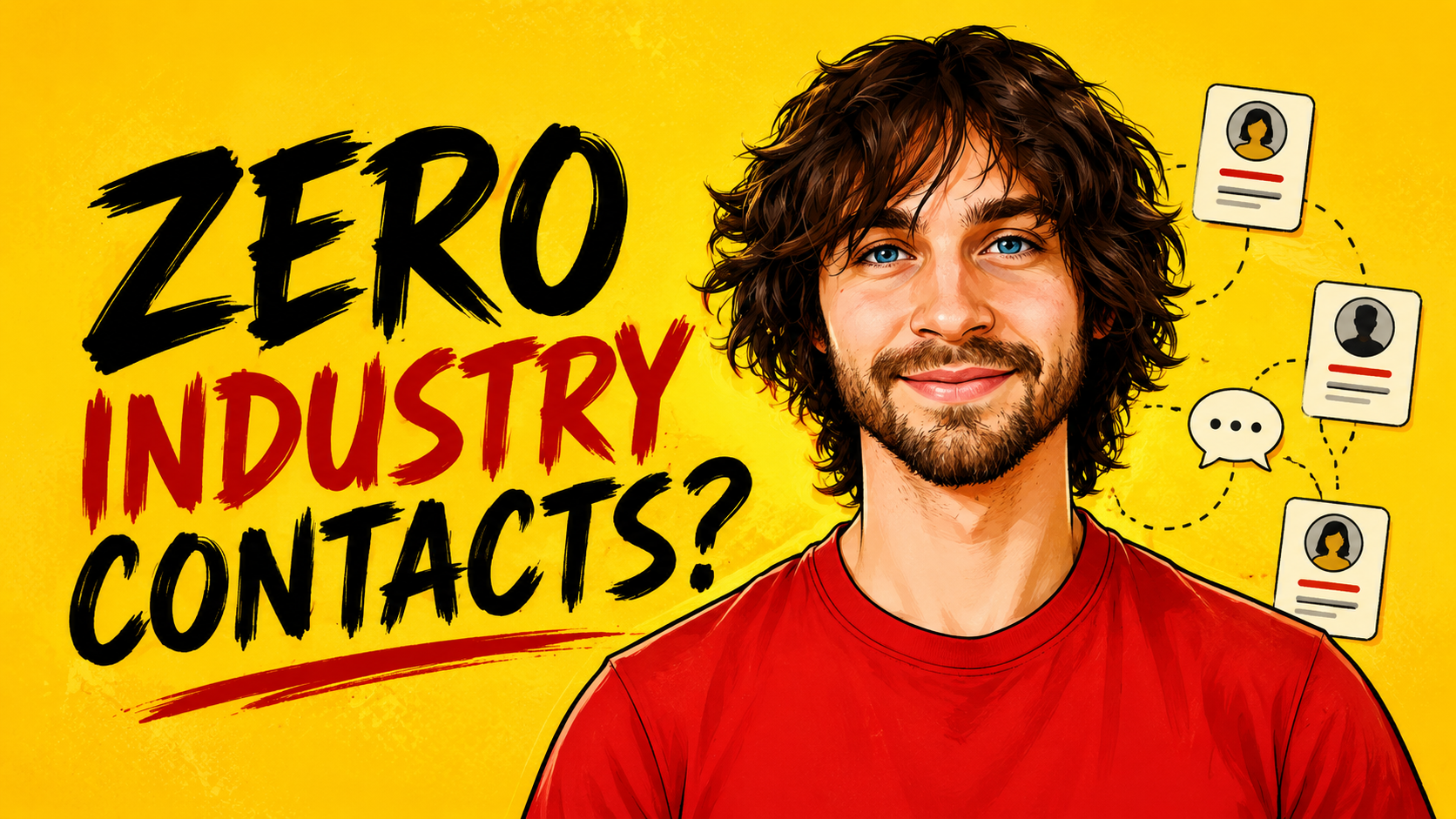
When I first started trying to build a career in film and TV, I did not know a single person in the industry.
No producers.
No executives.
No working writers.
No animation people.
No secret Hollywood uncle who could casually walk me into Netflix and say, “This Danish guy makes cartoons. Give him money.”
Nothing.
And honestly, it felt pretty lonely.
I was in Denmark, trying to write adult animated comedy shows, trying to understand how the industry worked, and trying to build something in a world where I had basically zero access.
So I had to start from scratch.
This is how I started networking in film and TV when I knew nobody.
And I really mean nobody.
Why I started networking early
When I first started this whole journey, I spent a lot of time studying people who had made it in film and TV.
Writers.
Creators.
Showrunners.
Producers.
People who had actually built careers in this space.
I was trying to find the common thing.
What did they all have?
What made them successful?
And honestly, in film and TV, a lot of them did not have that many obvious things in common.
Some went to film school.
Some did not.
Some started young.
Some started later.
Some came from comedy.
Some came from acting.
Some came from making their own stuff.
But there was one thing I kept noticing.
They did not do it alone.
That really stuck with me.
Because I think it is very easy, especially as a writer, to sit alone and think the whole game is just getting better at writing.
And obviously, getting better matters.
I am not saying it does not.
I spent a lot of time in phase one of my journey just trying to get good at writing comedy. Writing scripts. Learning structure. Learning characters. Learning how half-hour animated comedy works.
Beautiful.
Lovely.
Painful.
But I also started to understand that if I wanted to build a career in adult animation, I probably needed people around me.
People who could read my scripts.
People who could give me feedback.
People who could introduce me to other people.
People who could teach me stuff.
People who could maybe work with me one day.
People who understood this insane little journey and would not look at me like I had lost my mind every time I said, “I’m trying to create adult animated comedy shows.”
What networking has actually done for me
When I talk about networking, I mean actually building relationships with people.
There are a lot of practical benefits to that.
People in my network have read my scripts.
They have given me feedback.
They have taught me things about the industry.
They have introduced me to other people.
They have supported my work online.
Some have become friends.
Some have become people I can relate to when this whole thing feels hard and weird and impossible.
And that has been really valuable for me.
Where I started
The platform I used a lot in the beginning was Stage 32.
I have spent time on Stage 32 basically every day since I started.
I have not missed one day in the two years that I have been doing this.
There are a lot of people on there.
Total beginners.
Writers.
Actors.
Producers.
Executives.
People at very different levels.
That helped me because I could start talking to people without needing permission from some magical industry gatekeeper.
I could just reach out.
And I did.
A lot.
I think when I first started, I sent out maybe 100 or 200 connection requests a day on Stage 32.
Seriously.
The LinkedIn regret
One thing I really wish I had done earlier was start building my network on LinkedIn.
Big mistake.
I did not take LinkedIn seriously enough from day one.
And I regret that.
Because there are so many people in film, TV, animation, development, production, marketing, and entertainment on LinkedIn.
If I could go back, I would probably send out a few connection requests every day from the beginning.
Nothing crazy.
Just consistent.
Five good connection requests a day for two years adds up.
That is the annoying thing about simple stuff.
It works if I actually do it.
What I actually said to people
My opening message was usually a question about them.
That was the key for me.
I tried to make the first message positive.
Something like:
What has been your favorite project to work on?
What are you working on these days that has you excited?
What has been your favorite highlight this year?
What is your favorite animated show?
Something that gives the other person a chance to talk about something they enjoy.
I did not want the first message to feel like:
Hello stranger. Please help me achieve my dreams before lunch.
That feels a little intense.
And I definitely did not want to open with my entire life story.
There is a time and place for the 9 paragraph emotional manifesto about my dream of building adult animated comedy series before I die.
The first message is probably not it.
So I asked questions.
Then I listened.
That part is important.
I think one of the things that helped me the most was listening more than I talked.
Ask a question.
Actually care about the answer.
Ask a follow up.
Let them talk about themselves.
People usually like talking about things they care about.
Crazy discovery.
Scientists are baffled.
I do not message everyone the same way
One thing I learned pretty quickly is that I do not reach out to everyone the same way.
If someone is around my level, or just a few steps ahead of me, I feel much more comfortable making small talk.
I might ask about their favorite project.
I might ask what they are working on.
I might build the relationship slowly.
But if someone is way higher up, I do not approach them the same way.
If someone is a vice president at a major company, I am probably not going to message them and ask:
“What’s your favorite movie?”
I try to respect their time.
That was something I had to learn.
The goal was usually a coffee meeting
For people closer to my level, my basic process was pretty simple.
Reach out.
Ask a question.
Chat back and forth.
Build a bit of rapport.
Make it clear I am actually interested in them.
Then, if it feels natural, ask if they want to have an online coffee meeting.
Since I live in Copenhagen and a lot of people I talk to are in Los Angeles, most of these have been over Zoom or Google Meet.
Online coffee.
The least glamorous version of Hollywood networking.
But it works.
At least it has for me.
And then after the call, that person is in the network.
Now there is some relationship there.
Now I can follow up later.
Now I can support their work.
Now maybe they can support mine.
Now we are not strangers anymore.
Networking should go both ways
I also think it is important to say that networking should not just be about what other people can do for me.
That can get gross pretty fast.
There are a lot of things other people can do for me.
Yes.
Feedback.
Advice.
Introductions.
Support.
All of that.
But there are also things I can do for other people.
I can read someone’s script.
I can give feedback.
I can support their work.
I can introduce them to someone else if it makes sense.
And honestly, helping other people has helped me too.
Giving feedback on someone else’s script has made me better at writing my own scripts.
Seeing what works and what does not work in other people’s stories has taught me a lot.
So even from a selfish perspective, helping people has been useful.
But also, it is just a decent thing to do.
Annoying when morality and strategy overlap like that.
Why this matters for adult animation
For me, this all ties directly into adult animation.
I am not trying to build a career where I quietly write scripts forever and hope someone eventually knocks on my door.
I want to create animated comedy series.
I want to produce things.
I want to build worlds and characters and shows.
And that takes people.
Animators.
Writers.
Producers.
Executives.
Voice actors.
Editors.
Designers.
Composers.
People who understand production.
People who understand development.
People who understand how a show actually moves from an idea to something people can watch.
So networking is not separate from the creative work for me.
It is connected to it.
If I want to make adult animation, I need to get better at writing.
I need to produce work.
I need to understand the industry.
And I need to know people.
The simple version
If I had to simplify how I started networking when I knew nobody, it would be this:
I picked platforms where film and TV people were already hanging out.
I reached out consistently.
I asked positive questions.
I listened more than I talked.
I built rapport before asking for anything.
I asked for online coffee when it made sense.
I followed up.
I kept doing it.
Definitely worthy of a dramatic Hollywood montage where I sit at my laptop and slowly develop worse posture.
But that is really how it started.
Not with one magical message.
Not with one powerful person discovering me.
Not with me being ready.
Just repeated small attempts over time.
And if I could go back, I would start even earlier.
Especially on LinkedIn.
That one still hurts.
Peace.


